



Sushi recipes
The Ultimate Guide to Making Restaurant-Quality Sashimi at Home
Learn how to make mouth-watering sashimi in the comfort of your own home with this ultimate guide. Elevate your sushi game today.

Home » Blue Sakura Zwolle review: all-you-can-eat sushi that actually tastes good
I recently met up with a few former colleagues from Jetix. We wanted to catch up and, above all, enjoy a good meal. This time, we chose Blue Sakura in Zwolle. For me, an evening like that is never really just “ordinary.” I’m a sushi chef, after all, so I always look at my plate and the restaurant I’m in a little differently.
Still, I just wanted to enjoy myself that evening. No work, no camera, no class. Just sitting around the table with old friends, the old-fashioned way. And it worked out more than fine. In fact, it turned out to be a surprisingly fun and, above all, cozy evening.
It had been a long time since I’d seen those coworkers. You know how it goes. You promise each other to call and see each other at least once every few months… and then time just flies by before you know it. But as soon as we sat down, we clicked right away. Old stories, new stories (lots about my trip around the world, of course), lots of laughter. Exactly why you go out to dinner together.
Blue Sakura is an all-you-can-eat sushi restaurant. Places like that often make me a little nervous right away. Because “all-you-can-eat” and good quality don’t always go hand in hand. Fortunately, that wasn’t the case here. I’ll tell you more about that in a moment.

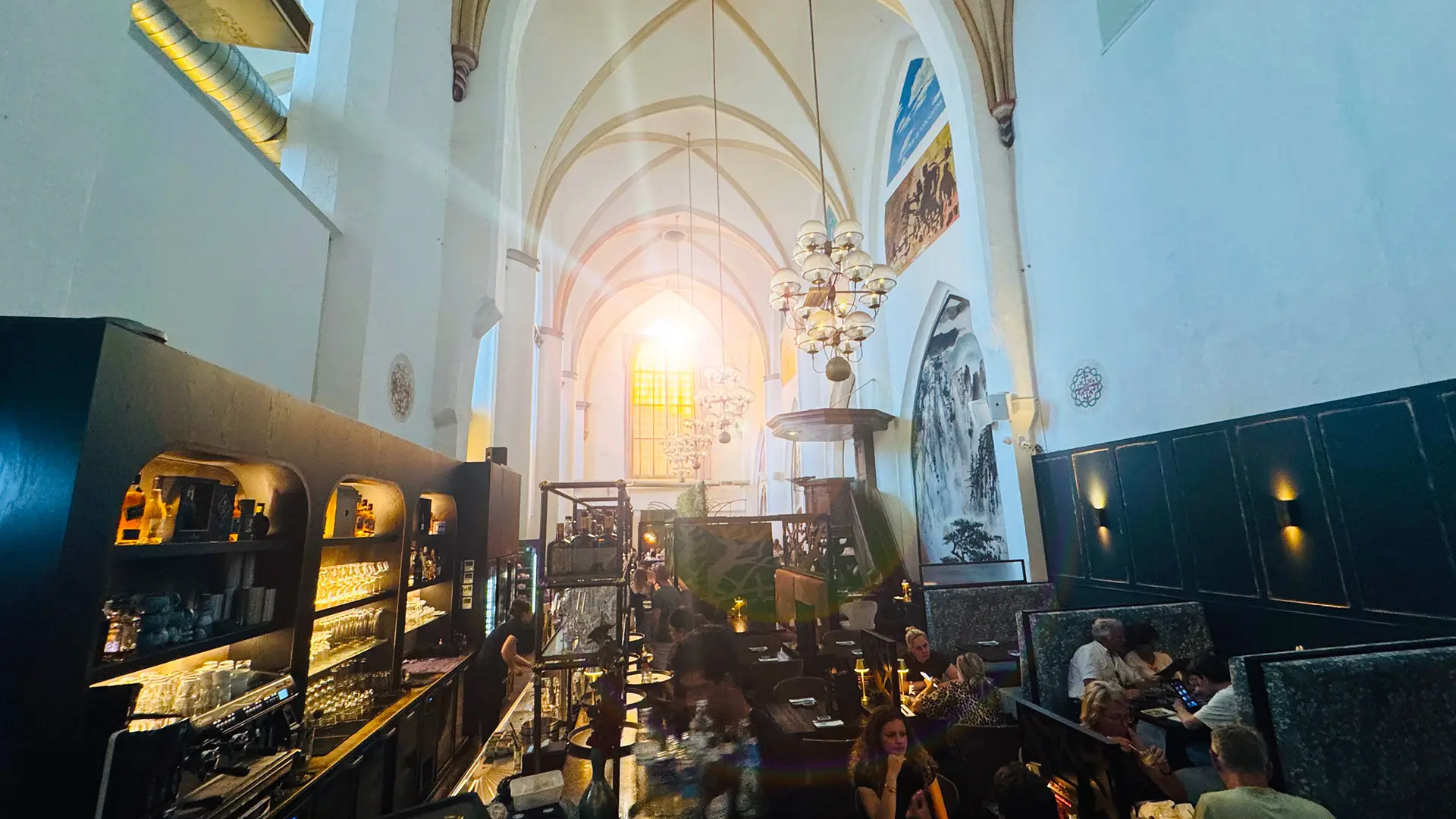
First, a few words about the location, because it’s truly special. Blue Sakura is located in the old Bethlehem Church, right in the heart of Zwolle’s beautiful city center. The moment you walk in, you stop in your tracks. The space is absolutely stunning, and it feels quite surreal to eat sushi here.
They’ve done a great job of preserving the original features. The grand organ is still there. The high vaulted ceilings give the hall a stately air. That instantly adds a touch of elegance to your dinner party.
Outside, there’s an incredibly cozy patio. It’s located on a charming square surrounded by several restaurants and patios. On a beautiful evening, you can sit there enjoying a delicious meal and chatting, with laughter and conversation all around you. In short, the atmosphere here is just perfect.
I think that’s much more important than most people realize. After all, dining is about so much more than just taste. The setting, the lighting, and the sounds all come together to shape the atmosphere of your evening. And dining in an old church just has something… well, something magical about it.
Zwolle is actually perfect for that. The city center is compact and charming. You’ll find nice outdoor cafes and restaurants everywhere, and they even have an ice cream parlor (Salute) where people from all over the region come to enjoy an ice cream. And the Bethlehem Church is right in the middle of it all, within walking distance of everything. Want to make a night of it? Then you can easily combine dinner with a drink just down the street. So much fun!

Just a quick explanation, because this is exactly where my work comes in. During my trip around the world, I spent eight weeks in Japan dining at restaurants run by true sushi masters. That’s where I learned what sushi is really all about. It’s all about balance.
Those eight weeks completely changed my perspective on sushi. At first, I thought I already knew quite a bit. But in Japan, I basically had to start all over again. I asked the master chefs a lot of questions… and watched and tasted a great deal.
Of course, I’m more than happy to share that knowledge at my School of Sushi—in the Netherlands, online, and during my on-site sushi workshops. With me, people don’t just learn a trick. They learn why something works. And that’s exactly the perspective I brought to Blue Sakura.
Good sushi isn’t about big bites. It’s about balance. The rice, the fish, the temperature, the portion size—everything has to be just right. A sushi master spends years perfecting that very balance.
That’s why I always do the same thing at an all-you-can-eat sushi restaurant. I don’t order the same thing three times. With my former coworkers Johan and Danny, I chose something different each time. That way, I got a much broader sense of the quality. That’s my little trick, and I’m happy to share it with you.
Because that way, you can sample almost the entire menu in a single evening. You can immediately see what the restaurant excels at. And you can also see where it falls short. Let’s be honest: at an all-you-can-eat restaurant, the bar is sometimes set very low.

You might be wondering why I’m so critical. Here’s why. All-you-can-eat is all about volume. You pay a single price and eat as much as you want. For the restaurant, that mainly means doing the math.
Fish is expensive. Rice is cheap. So it’s very tempting. That’s why many restaurants pack extra rice into each bite. This makes your plate look nice and full, but all you really taste is the rice.
There’s something else to consider. At an all-you-can-eat restaurant, things have to move quickly. The kitchen operates at a fast pace, not with precision. And precision is exactly what good sushi requires. So those two often clash.
Still, it doesn’t have to go wrong. A restaurant can also choose to prioritize quality within its concept: smaller portions, better fish, and well-balanced dishes. Blue Sakura does this very clearly. And that’s why it was a pleasant surprise. Fortunately, they’re the exception!

Let’s start with the nigiri, because that’s what really matters to me. At a lot of all-you-can-eat sushi places, you get really thick nigiri—a huge ball of rice with a thin slice of fish on top. That doesn’t make me happy. No, definitely not.
Fortunately, things were different at Blue Sakura. The nigiri were a normal size. The fish on top tasted good and fresh. And the ratio of rice to fish was just right.
You might be thinking: Does the size really matter that much? Yes, it does. And I’d be happy to explain why. A piece of nigiri should fit in one bite. If there’s too much rice, you can barely taste the fish.
In Japan, nigiri is small and light. The rice is loosely packed, not a hard lump. The fish lies smoothly on top and is the star of the dish. I always missed that aspect at all-you-can-eat restaurants. Here, it came surprisingly close.
So when I tasted that first piece of nigiri, I was immediately relieved. It wasn’t quite as perfect as in Tokyo, but it was still pretty good. For an all-you-can-eat place in Zwolle, that’s really impressive. Kudos for that.

I was also impressed by the uramaki. They had kept them nice and small. And that’s no coincidence—it’s a deliberate choice. A good choice, in my opinion.
Because with a large, thick roll, you mainly taste the rice. The filling tends to get lost a bit. With a smaller uramaki, everything stays in balance. You can taste the fish, the vegetables, and the sauce all separately.
This makes for a much more enjoyable taste experience. Every bite feels complete. Nothing overpowers the others. Just the way it should be.
These are the details I always emphasize in my workshops. Making sushi isn’t about doing a lot; it’s about precision. And it was nice to see that Blue Sakura gets that, too.

Want to know where sushi really begins? With the rice. Not with the fish, as many people think. The rice is the foundation of every bite.
In Japan, they call this rice “shari.” And a sushi master takes great care in preparing it. The grains should stick together, but never become mushy. The flavor comes from rice vinegar, a little sugar, and some salt. If you’re a master chef, you’ll also mix in some kombu, which adds even more umami flavor to your rice.
Temperature also plays a role. Good sushi rice is slightly warm, around body temperature. If it’s too cold, it gets hard. If it’s too warm, it falls apart. It’s a delicate balance.
That’s why, at every restaurant, I check the rice first. Was it perfect at Blue Sakura? No, that would be asking too much. But it was well-prepared and pleasantly light. And that immediately made all the appetizers taste better.
Just a quick lesson to throw in here, since this comes up a lot. Many people confuse the different types of sushi. That’s totally fine. But it’s nice to know what you’re eating.
A nigiri is a bite-sized piece of rice topped with fish. Deliciously simple and pure. A maki is a roll with nori, the seaweed, on the outside. And an uramaki is exactly the opposite. The rice is on the outside and the nori is on the inside.
At Blue Sakura, I mainly tried nigiri and uramaki. Both were prepared with care. And now that you know this, you can order with a little more knowledge from now on. A little tip goes a long way.
By the way, we ordered quite a few different kinds of rolls. With each new variety, I took a critical look. But the quality remained consistently good. That inspires confidence.

Blue Sakura doesn’t just serve sushi. You can also choose from other dishes, such as spring rolls, Gong Bao chicken, and grilled salmon. So there’s plenty of variety for everyone at the table.
To be honest, there’s one thing you can tell right away from the menu: this restaurant isn’t run by a Japanese person. That’s because authentic Japanese cuisine works differently—there, sushi stands on its own much more.
But is that a bad thing? No, not at all. It’s just good to know what you’re getting. You’re not coming here for a strictly authentic Japanese experience. You’re coming here for a fun evening with delicious and varied food.
And Blue Sakura does a great job of that. The additional dishes make it accessible. Is there someone at the table who isn’t a big fan of raw fish? Then there’s always something else to choose from. That’s a real plus when you’re dining out with a group.
I’ll admit, I’m a bit of a purist myself. For me, sushi can definitely be the centerpiece. But I totally understand that not everyone feels that way. And a night out is also about enjoying each other’s company. If everyone finds something on the menu that suits them, that’s really a win-win.

Now I’m getting to my one and only real complaint. We ordered using a tablet on the table. And I really hate that. Sorry, but that’s just how I feel. I really don’t like it at all.
I really miss the human interaction. No small talk with the waitstaff, no complimentary treat from the house, no banter among the staff. No, just tapping on a screen. For me, that takes away some of the charm. Maybe I’m just very traditional in that regard… it’s possible.
My former coworkers actually had a very different opinion on that. They actually liked the iPad. It’s nice and fast, has pictures for everything, no hassle, and you set your own pace. And I totally get that.
So it really comes down to personal preference. Do you value efficiency? Then a tablet like this works great. Do you, like me, enjoy a little chat and some personal attention? Then it does feel a bit cold.
To me, hospitality goes hand in hand with good food. A good host or hostess really makes your evening complete. Still, I realize I’m old-fashioned in that regard. Younger guests, on the other hand, think it’s great. And in Japan, I saw this happen regularly in sushi restaurants (especially the ones with conveyor belts), so they’re familiar with this phenomenon there, too.
Just a practical note, in case you’d like to go there yourself. Who would really enjoy this restaurant? I think it appeals to a very wide range of people.
It’s perfect for couples looking for a night out. The atmosphere in the old church is romantic, and they have cozy seating areas where you can enjoy each other’s company. But it works just as well for groups. A night out with friends is a great idea here.
Because there’s something for everyone. Sushi lovers will be in heaven. And if you don’t like sushi, just choose something else. That way, everyone’s happy.
Here’s a quick rundown of what caught my attention:
Are you planning a birthday party, a reunion, or a dinner outing? Then this is a safe and enjoyable choice in Zwolle—especially if your group has a variety of tastes.
Time for my rating. I give Blue Sakura in Zwolle a 3.7 out of 5 stars. And for an all-you-can-eat sushi restaurant, that’s a really good score.
Because let’s be honest. My standards are really high after my time in Japan (sorry!). Ever since that trip, I know exactly what perfect sushi looks and tastes like. I measure every restaurant against that standard. And yet, Blue Sakura managed to surprise me in the best possible way.
The quality of the sushi was excellent. The portions were just right. The atmosphere and location were top-notch. The only things that brought my rating down a little were the tablet and the fact that the menu wasn’t entirely Japanese. But for most people, those aren’t deal-breakers at all.
So, are you looking for a cozy spot for (all-you-can-eat) sushi in Zwolle? Then don’t hesitate to make a reservation at Blue Sakura. The food is great, the atmosphere is wonderful and super relaxed, and it’s a place where everyone feels welcome.
Would I go back there myself? Absolutely. Especially for an evening out with a larger group. The combination of that unique church and high-quality sushi makes it just a little more special than your average restaurant. And that’s exactly what makes an evening like that so much fun, in my opinion.
After an evening like that, I always get that itch again. Because eating out at a restaurant is fun. But learning to make your own rolls is even more fun. And then you immediately understand where all those details come from.
In my workshops at School of Sushi, I’ll guide you through it all. You’ll learn the right size, the perfect rice, and the balance that I appreciated so much at Blue Sakura. No complicated fuss—just roll them up and taste them. And laugh—lots of laughter.
Do you really want to learn how to make sushi? Then you know where to find me. Be sure to stop by Blue Sakura sometime just to enjoy the atmosphere. And then come see me to learn how to make it yourself.
See you soon,
Rik

Sushi chef and founder of the School of Sushi. Making your own sushi is easier and more fun than you think! Through workshops and online courses, I’ll show you how to roll delicious sushi for your friends & family. Ready to roll?


Learn how to make mouth-watering sashimi in the comfort of your own home with this ultimate guide. Elevate your sushi game today.

Curious about Dudu 31 restaurant in Berlin? Read our review of this trendy sushi hotspot in a side street of the famous Kurfürstendamm.

Kewpie mayo is not just any mayonnaise! Find out why it’s the world’s tastiest, how to use it and where to buy it. Click to read more!

Making your own sushi is great fun, but what do you do with the leftover rice? Can you store sushi rice? I’ll explain the best way to do this!

Discover how sustainable Australian seaweed takes sushi to the next level. My visit to Southern Seagreens was full of flavor and inspiration.

A ‘Special roll’ is special here, too!


Master the art of sushi-making at home with my fun online course, featuring 50+ step-by-step videos, expert tips, and delicious recipes to impress your loved ones!